Prototype, 2017
11 water-cooled GPUs in one chassis
A dual-CPU server platform in a single CAD-designed case, cooled by one water loop.

GRUENCY / AI workstations
Model training and local LLM inference keep a machine at full power for hours or days. GRUENCY sizes GPUs, power delivery and cooling for that continuous load. Each AI workstation is tested under burn-in before delivery.
Compute, memory, PCIe lanes, power and noise are specified together, starting from the models you run.
Each AI workstation leaves Warsaw with its own test record. It includes a sustained full-load burn-in, a thermal profile for every GPU and a noise check against the agreed target. On arrival, Sebastian commissions the machine remotely into your environment. Speed is measured as well: GPU and memory performance, and tokens per second on language models.
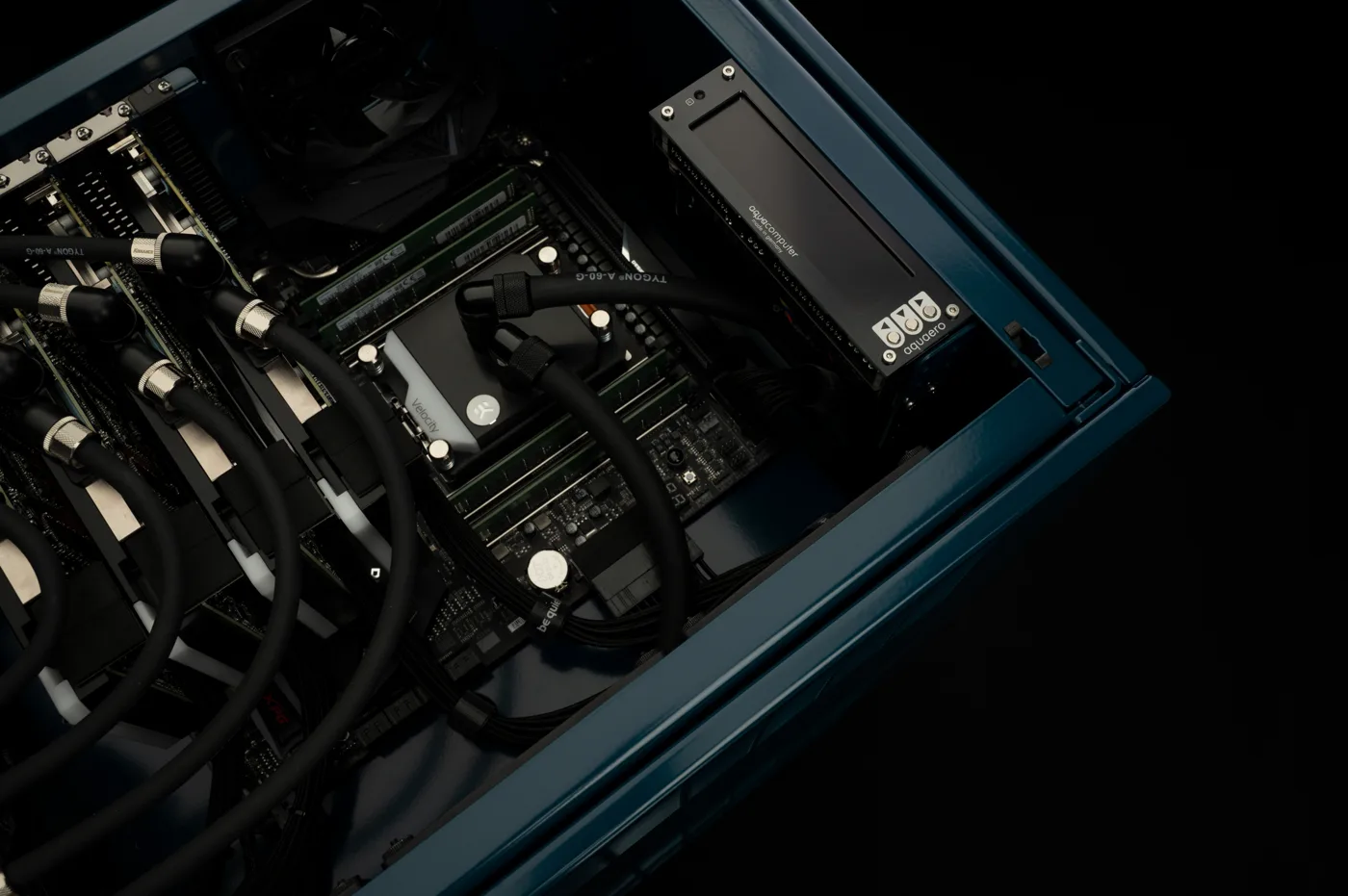
A dual-CPU server platform in a single CAD-designed case, cooled by one water loop.
Vendor work for NVIDIA on AI, rendering and visualisation systems. WS.COMPUTER clients are based in over 30 countries.
Machines across successive GPU generations, each specified for its workload.
From the models you run. Parameter count, quantisation, context length and batch size determine the VRAM and memory bandwidth needed. This is the first question in the consultation.
It depends on sustained power draw and the noise target. Two GPUs can often be air-cooled. Four or more GPUs under continuous load usually need a custom water loop.
Yes. Machines are delivered across the EU and worldwide in custom transport packaging. Remote commissioning into your environment is part of every delivery.
Describe the models, the data and where the machine will be used.
Or email info@gruency.com · Configure at WS.COMPUTER